ritaxis: (hat)
Monday, March 31st, 2014 11:09 am
I'm surrounded by young people trying to get the jobs they trained for. Or trying to get any job at all. And not just the very young: I have folks around me who are closer to forty than thirty, well-educated, well-trained, successfully employed in the past, who can't get work in their field or any other. Even the terrible jobs are ridiculously hard to get. And they are getting more terrible, as well. Wages are falling, conditions get ever more grueling, workers' rights are lost in the courts.

Is it any wonder I have taken my creaky old self out of the job market?

So what happened? I've seen automation take the blame. But it's just not true for the jobs my young friends are looking for. In many cases they are looking for jobs that will not be automatable until we have human-replacing artificial intelligence. Robots can do a lot of things, but they can't do these things.

What's happening is two things: work that needs to be done is not being done, and work that is being done is being done by people who are working too hard. People who work eighty hours a week (and like as not get paid for thirty), people who have to attend to too many tasks at once.

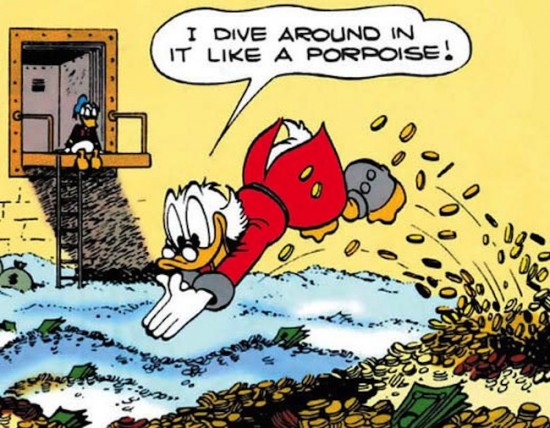
Roads are going unmended, schools are being allowed to deteriorate, hospitals are understaffed, inspections are not being done. How come? Because these are all public functions, publicly funded for the public good, and all the funds are being diverted to private hoards. While West Virginia's water supply went unprotected (and may be permanently damaged), the money was being shoveled into Scrooge McDuck's swimming pool.
ritaxis: (hat)
Wednesday, September 18th, 2013 08:00 am
Adrian Moore, from the Koch Brothers-funded magazine "Reason," doesn't think that unskilled laborers should expect to make a living from their work (link goes to Crooks and Liars' Video Cafe).

I can't think that he actually means what he's saying here. I think he's spent so much time justifying the high salaries of his compatriots that he thinks "make a living" means "make a fortune."

Or, maybe, he really does think that malnutrition, homelessness, and premature death for a large class of people is an acceptable price to pay for a cheap strawberry and a clean hotel room.

Either way, he's in that space where the distinction between evil and stupid is not possible to make.
ritaxis: (hat)
Friday, April 19th, 2013 02:59 pm
So Wednesday, in West, Texas, an explosion killed at least fourteen people (I expect the number to rise as I believe that people are still missing). The explosion was the result of criminal behavior: the fertilizer plant that exploded was operated without a safety plan for years, and had been cited for unsafe practices, which as far as I can tell were never ameliorated because the state government signed off on a statement by the factory owners that nothing bad could ever happen there

You can see images of the destruction here. I recommend it only if you've been constantly refreshing reports on the Boston Marathon bombing.

I went looking to see if President Obama had promised to bring the perpetrators of the West, Texas explosion to justice, as he promised to bring the perpetrators of the Boston Marathon bombing to justice.

As far as I can tell, what the President has promised the folks of West is FEMA support, which is good, but  . . . why not justice too?

Why, out of all the media reports I have looked at, has only Democracy Now expressed outrage at the fact that OSHA last stepped foot in this factory in . . . (I don't know. The early transcript of the conversation with the labor reporter Mike Elk said "at least five years," but I see a reference to 1985 somewhere)? That the state government actually accepted the plant's own finding that nothing bad could ever happen in a factory full of anhydrous ammonia and so therefore they didn't need a safety plan?

Why are our national spokespeople not vowing to bring to justice the owners of the plant, the (non) regulators who signed off on their criminal behavior, and Governor Rick Perry, who said on April 9th, less than two weeks before this explosion: ""The men and women in Texas know something now after a decade-plus of our governorship and our policies being implemented by a Republican House, Senate, lieutenant governor and speaker. We’ve kept our tax burden as light as we could and still delivered the services that the people of Texas desire, and we have a regulatory climate that is fair and predictable. I cannot tell you how important is predictability and stability in the regulatory climate."" (quote from Democracy Now transcript linked above).

(I can tell you what is predictable. It is predictable that if you do not regulate and enforce the behavior of capitalists, they will cause real harm, chronically and actuely)

Well, of course I know the answers to this. I don't want to belittle the horror of two men setting off bombs at the Boston Marathon and murdering a handful of people and injuring nearly two hundred more. What I want to do is to point out that it is even more horrible that our governmental institutions are colluding with or incapable of engaging with criminals who continue their life-threatening behavior for years, backing it up with economic blackmail, and that when people die and their homes are destroyed because of it, nobody seems to care much.
ritaxis: (hat)
Thursday, December 27th, 2012 09:51 am
An explanation of why the cost-of-living discussion seems so divorced from reality.

The article I got it from, which tells us what we already knew about why people don't buy as much these days as the retailers want us to.

Really, you can't just keep on taking money out of the system, and laying people off, and cutting their wages, and cutting off their hopes of promotion, and cutting the services you provide to them, and expect them to have money to spend on things.

And while I'm talking about this, while I'm worried about myself and my contemporaries too, I do wish we'd take a moment out of discussing what they're doing to us old folks (threatening out lives, actually) to talk about what they're doing to the young folks (throwing them under the bus altogether). When you cut public spending in the areas of basic services, and infrastructure, and education, and research, you not only bring down the present quality of life and throw all these people out of work who are in the prime of their life, you choke off the early careers of an entire generation coming up. People who ought to be getting their start as young public servants are marking time with their degrees, squeaking by on partitime jobs they are way over-qualified for. People a bit younger are not even getting the qualifications because the colleges have cut back on the classes or simoply become too expensive to attend.

How is this supposed to fix an economy?  It'll fix the economy, yes, in the older sense -- stick it tight so it can't move.
ritaxis: (Default)
Monday, July 23rd, 2012 12:59 pm
James Dimon is paid a thousand times as much a year as I make from my wages and also my widow's pension put together.

That is, you could gather up 999 more of me and give them all what I get and all of us together get by on less than what James Dimon does (since you know he makes a lot more money in a year than his salary).

James Dimon plays liar's dice with other rich peoples's money.

I raise human beings.

Oh yeah, and while he's not getting his taxes returned to their proper level, I'm facing another cut.
ritaxis: (Default)
Thursday, June 14th, 2012 02:02 pm
Here's <a href="http://youtu.be/BGpEXKgU20A">Humboldt County's take on the issue of ch8ildcare funding.</i>

The governor's latest proposal would throw 62,000 families out of state-subsidized preschools, among other atrocities.
ritaxis: (Default)
Sunday, November 20th, 2011 11:14 am
Yesterday I wrote 2000 words and got a tremendous lot of story business accomplished. Today it's almost eleven, I've written 1700 words so far and I'm on a long break trying to get my unconscious brain to figure out what bridges what I just wrote with the next thing I know. After perilously close to 40 000 words the first on-screen utterly overt fantastical thing is about to happen. And it's something I've been looking forward to for a long time. But I'm kind of stuck in this little lull before the event, and I should just fling in the crisis and end the chapter right now on the cliffhanger.

But there's another event that I thought would happen in the same calendar year, and I can't figure out how it fits in with the disease outbreak that's about to dominate everything. So I'm dithering about it. It involves the music tutor changing his mind about folk music and suddenly becoming Bela Bartok. Yeah, the same music tutor who was a tossed-off line a few chapters ago: now this transformation has tremendous consequences for Yanek, mostly indirectly . .

On another front.
After reading that one in three Americans are living in or near poverty, I went looking to find out what the actual poverty threshold is. I found a nasty wikipedia article that claimed that poverty is overstated because the people we call poor in the US buy unnecessary things and own small appliances that some middle-class people don't, I finally found the US Census definitions. You have to wade through a lot of pages that tell you other things before you can find the one that allows you to download a spreadsheet with the actual numbers on it. There's also a link to the poverty levels that are used to determine if you can have benefits -- those levels are different. For some family sizes, the threshold is higher for benefits, but for people like me the HHS level is considerably lower than the census one. So you can count towards an understanding of how many needy people there are, but you can't get help.

Anyway, the surprising thing to me is how very low the poverty threshold is. For a person in my condition -- single and under 65 -- it's $11,344. For a family of four with two kids under eighteen it's $22,113.

Personally, it turns out, I am nowhere near the poverty line. If I had any kids, though . . . I'd be real close.

On the other hand . . . rent for a small apartment in Santa Cruz runs over thousand dollars a month: mostly over fifteen hundred a month. So a family in Santa Cruz would likely have four thousand dollars or less to cover everything else. And if I didn't have artificially low housing expenses due to having lived in the same house for thirty-four years and never being sucked into a variable-interest refinance scam, I would be living in my car at that level. Which would not be running, because I wouldn't be able to maintain it. And by the way, living in your car is extremely illegal in Santa Cruz. Fortunately for everyone, I am not living on eleven thousand a year and I do have artificially low housing expenses.

Do I have a point with this? Oh, right, if a third of Americans make little enough money that they could not both feed themselves and rent an apartment, are we still the richest country?

Now I have to figure out how to end this chapter and get out of bed.

edit: so I did it! I got to the end of the chapter, I got the cliffhanger introduced and effected, and the next bit should be pretty obvious tomorrow.

Actual day's total: 2600 words, chapter is 5200, book is I think 39 600 or so. I'll do an accurate-ish count on another day.
ritaxis: (Default)
Friday, October 21st, 2011 08:56 pm
Mostly tangential to the real point of things, but yeah.

Pat Buchanan recently held up California as a bad example. He said because the state is "de-Christianized" (what does that ebven mean?) that there's a black-brown war going on, and California has "the worst bond rating" of all the states.

We actually have dropped to A-, guys. This is actually the lowest bond rating for the states, which are mostly AA and AAA. But let's unpack that a bit. First, what does A- mean?

It's between A: "strong capacity to meet debts but somewhat more susceptible to adverse changes in economic conditions" and
BBB: "Adequate capacity to meet debts, but adverse economic conditions or changing circumstances are more likely to lead to a weakened capacity."

In other words, A- means you can pay your debts just fine unless some asshole decides to take you down.

Second, why is California considered to be more vulnerable than, say, Mississippi (AA)? Could it be influenced by such discrepancies as the fact that Mississippi gets $2.02 back from the federal government for every tax dollar they send in, whereas California gets $.78? (California does not have the biggest negative discrepancy here: oddly, seven states get less tax dollars back than California. I think they're all "blue" states: follow the link and go to the bottom of the graphic, and tell me what you think).

It's not that all the states should get back the same amount from the government. In fact I think it's appropriate that Mississippi get a lot, because it's a needy state: I'd love to see an analysis of the expenditures, though, because I suspect that Mississippi would be a lot better off by now than it is if that money had been spent to actually develop a decent infrasctructure and balanced economy for the people living there.

California has been under steady assault since the days of Reagan as governor. All that viciousness where the poor are blamed for everything and taxes on the rich are held up as the greatest evil done by government started here and then. Proposition 13, which held property taxes down and crioppled local governments' ability to levy fees for infrastructure, was only the starting indicator of a long line of effective attacks on California civilization. One of the most recent was the predatory lending and robo-signing foreclosures activity, which was as heavy in parts of California as it has been anywhere else. And there was that whole corrupt Schwarzenegger regime, and the importation of Texas corruption and fake for-profit charters into what had been a pretty healthy school system. And more.

And yet -- somehow, California continues to produce a huge share of the nation's green stuff and fruit, to lead in innovations in technology, science, and culture, to employ people to do necessary or desirable work . . . while suffering, like the rest f the country does, from the concerted criminal actions of the capitalist class and their cronies in government.

Oh yes, I almost forgot the other point. Really, why do we even quote Standard and Poor's anymore? Just because everybody else does it? If there's anybody who ought to have lost their credibility by now, they are it. From rating highly a whole bunch of bad paper just before the crash and also afterwards to down-rating countries because they were insufficiently cruel to their working classes and their most vulnerable people, right down to making a multiple-trillion dollar error in assessing the United States' credit-worthiness, could they have been any more stupid, evil and laughable?

By the way, none of this should be construed as an attack on Mississippi. I wish every state well, really.
ritaxis: (Default)
Saturday, October 15th, 2011 01:53 pm
So people have been pointing out that Herman Cain's stupid taxation proposal sounds like the default tax structure in Sim City.

Well, yea, but the secret there is -- you can't play a successful city on that. You go bankrupt in a few years, and you never get a chance to build your economy.

There is a sure-fire method to having a successful Sim City. Republicans would hate it (and I believe that is why Sim City Societies was born, but I never played the game despite always being interested in any new Sim City entry, because the enthusiastic walkthrough by the developers looked so heavily ideological and boring). How do you "win" at Sim City?

1. Pause the game as soon as you create your city. Also, turn off disasters.
2. Raise all taxes to -- I forget, but I think 15% is not too high to begin with.
3. Put in a little patch of roads, with a little patch of low-density (to begin with) residential, industrial, and commercial. This is because low-density is cheaper and you don't want to spend a lot until you have some income.
4. Put in a few amenities, including just-enough of basic services.
5. Run the game at medium or high speed. his is because it is very hard to sit there and do nothing, and you want slow and steady growth to start with, so you don't eat up your capital before you start seeing returns.
6.Add zoning in patches so that your sims don't have to travel too far to work or shopping. Increase density gradually. Keep adding amenities.
7. When the sim citizens begin to complain about taxes, give them more services or amenities, being careful not to overspend as you go.
8.When your income is stabilized and substantal, lower taxes in tiny increments, residential first.
9. When better, greener technology becomes available, gradually phase out the old and phase in the new.
10. Stay on top of water, power, and sanitation.
11. Skimp on police services relative to fire, education, utilities, entertainment, and medicine. Don't build police until you have a crime issue, then build them slowly and barely cover the map with them. Don't skimp on fire service, but don't overfund either. Give all services except for police almost as much as they ask for.
12. If you are offered a prison or a military base, turn it down.
13. If you are offered a garbage contract from your neighbor, you probably want to turn it down, no matter which direction it goes. If they send you the garbage the pollution and the landfill use will probably be too much to keep up with. If they take your garbage the cost will probably be too much. But there are exceptions to this.
14. Never underestimate the power of varying the size of civic improvements. A one-square park might do the trick for a particular neighborhood, and a huge stadium might be exactly what your city needs on another occasion.
15. You probably don't want to legalize gambling. But if you need a lot of money, it can be effective. But you should do away with it as soon as you are sure your economy has stabilized in the black for a while.

There you have it. As you can see, Republicans did not write Sim City. At least not Sim City, Sim City 2000, Sim City 3000, or Sim City 4. I should probably check out Sim City Societies some day. I don't think there's going to be another Sim City after that, since it did so badly. I read that people mostly hated it. I wonder, though -- the graphics were kind of cute . . .
ritaxis: (Default)
Sunday, November 14th, 2010 06:39 pm
I just got a push poll, the kind where you know exactly who set it up after only a few questions.  It's all about the desalination plant.

I reluctantly have to give them support on this, because the other alternatives are even less promising and more threatening.

Only thing is, since we've been having a striking lack of drought lately, I believe this gfives us time to go slow and address the real problems of the plan -- only addressed by one question in the poll: it's really really hard to protect the bay from the intake and outflow. 

The plan includes a prety good sounding approach to the problem of returnign the brine to the ocean .  The natural byproduct of a desal plant is of course hot, supersaline water.  In theplan as I understand it, they will mix the brine with the treated water from the sewage plant -- which is treated to nearly-drinkable levels (to be drinkable by legal standards it needs more chlorine, which is problematic on a few levels itself) -- and the resulting mixture, no longer hot or supersaturated, is piped out to the outer bay where it will disperse faster anyway, thus having less impact on anything.  I'm comfortable enough with that. And I know theat the plan as it existed a couple years ago involved a bunch of safeguards against sucking little invertebrates and stuff into the works, but I'm just not convinced that we've got that wired, you know?

Economic revocery note:

you could hire a whole cadre of people who used to be fishermen, factory workers, or construction workers, to monitor the health of the bay in conjunction with the desal plant.  This is not a cheap proposition: you'd be paying them skilled worker wages (according to former definitions, at that, I think), and it would "make the water more expensive."  But if the program is paid for by generalized taxes, and put into the category of "economic stimulus" because a cadre of decently-paid skilled workers who are tied by the nature of their work to the community in which they live will spend those decent wages on goods and services all over town.
ritaxis: (Default)
Thursday, January 14th, 2010 01:45 pm
On NPR I hear that the banks have a horrible dilemma. Because of the (implied irrational) resentment that the (implied ignorant and reactive) public has towards the "employees" (scare quotes explained in a moment) of the banks that caused our late meltdown, and "even though the banks have paid back their share of the bailout" (which is only true if you, as usual, ignore the true cost of the events), the banks are afraid to appear to be excessively "compensating their employees," but in order to attract and retain the best ones, they must offer competitive salaries and perks and bonuses.

Everything possible is wrong about this. I'm not sure where to start, so I'll start at the top, with my use of scare quotes. When NPR talks about "employee compensation" they are not talking about the custodians, the data entry techs, the accountants on the ground floor. Nobody gives any of these employees an extra paycheck that could buy a house on Nob Hill. Given the shrinkage of union membership these days and the tendency to temp out everything, they'll be lucky if they make more than minimum wage or have any benefits. So it's disingenious to use the word "employee" to blur the lines between these guys and the rest of us. And whether the copywriter did it on purpose or not, it does serve a purpose: to reinforce the message that the rest of the bit on the news is giving. Pity the poor banks. They are trying so hard to fix their mistakes, and we're so mean to them, and if we don't let them do what they want, they will just make a bigger mess . . .

When you use the word "compensation," too, you imply a lot of things. You imply thjat you're merely paying someone back for a tremendous sacrifice (or huge effort, or risk) they've made on your behalf. Now, in the case of the bank exectuives and board members, it might be true: they're all friends and cronies who have continued to get richer and richer for the most part during all this mess, so the sacrifice that's been made, and the effort that's been made, and the risk that's been taken, is, yes, on their behalf.

However the sacrifice and effort and risk has not been made by the people who are in line to get this money: no, I don't deny that they put in long hours in the office when they're not on tax-deductible lunches or paid vacations triple the length that the rest of us get if we get vacations (the closest many American workers get to a paid vacation is unemployment, or the pittance they get if they get hurt so badly they can't work any more). But the effort that is going into attempting to clean up the mess they made is being made by comparatively lower-paid government clerks and lawyers. The risk they took -- and failed to come through clean from -- was with the wellbeing of every human being on the planet. And the sacrifice that's been made has been the jobs, homes, health, general welfare, and peace of mind of countless working people who have still not been hired back to do the work of keeping society going.

Oh wow. Look at that. The work that these "best and brightest" executives in the financial industries have been doing over the last couple decades has caused widespread financial failure, greatly increased poverty, and social chaos. That's without getting into all the very central side issues, like the environment itself (I tried boiling that down to a phrase so I could reference it here, but I just can't). So -- how can you say they've been doing a good job that should be rewarded? How can you say that it's in anybody's interest, even the other exectuvies and board members of these companies, to retain them?

These people are either incompetent or criminal -- possibly both. But in either case, I don't think rewarding them is reasonable. So what if they leave?
They're worse than useless.

The financial industries should be looking for an entirely different sort of young executive to take their place. Only sociopaths and borderline sociopaths are solely motivated by reward. And we've seen what handing over your institutions to sociopaths leads to.

Alfie Kohn has made a life's work out of talking about the intrinsic rewards of doing competent, pro-social work (and how to raise and teach children with this in mind). Go read his stuff.

Just on the subject of getting the best to come work for you. I'm not much of a bragger, but I actually think I'm among the best at what I do. I am so much not a bragger that I had to force myself to write that sentence without qualifying it out of meaning, even though I know it to be true. Anyway. My boss got me to work for her, not by dangling large sums of money at me (she didn't have it to offer), but by offering me the chance to do the thing I do, and to do it in an environment that is devoted to that thing, and devoted to doing it well.

Just so you have something to compare, I make $14.00 an hour. My work saves lives. It keeps saving lives. It's a job that requires a college education, credentialing, and continuing education. In my case, there are three credentials and two years of graduate school involved. Most of the people where I work are bilingual or moving towards bilingualism.

(EMTs around here, who save lives more immediately than I do, make about the same, with worse benefits than I get)

So Anastasia Kelly, whose work at AIG helped to bankrupt thousands and to send them out of their homes and their jobs, not only left because she would no longer be making over $500,000 a year (which is a bit over $240 an hour if you work 40 hours every single week of the year) for her base pay</> not including benefits, perks, or bonuses: she will get several million dollars for her severance pay. She's entitled to it under AIG rules because she quit for a good reason, getting her salary lowered. But let's go back to AIG's other employees -- how much severance pay will they get if they quit when their salary is lowered?